
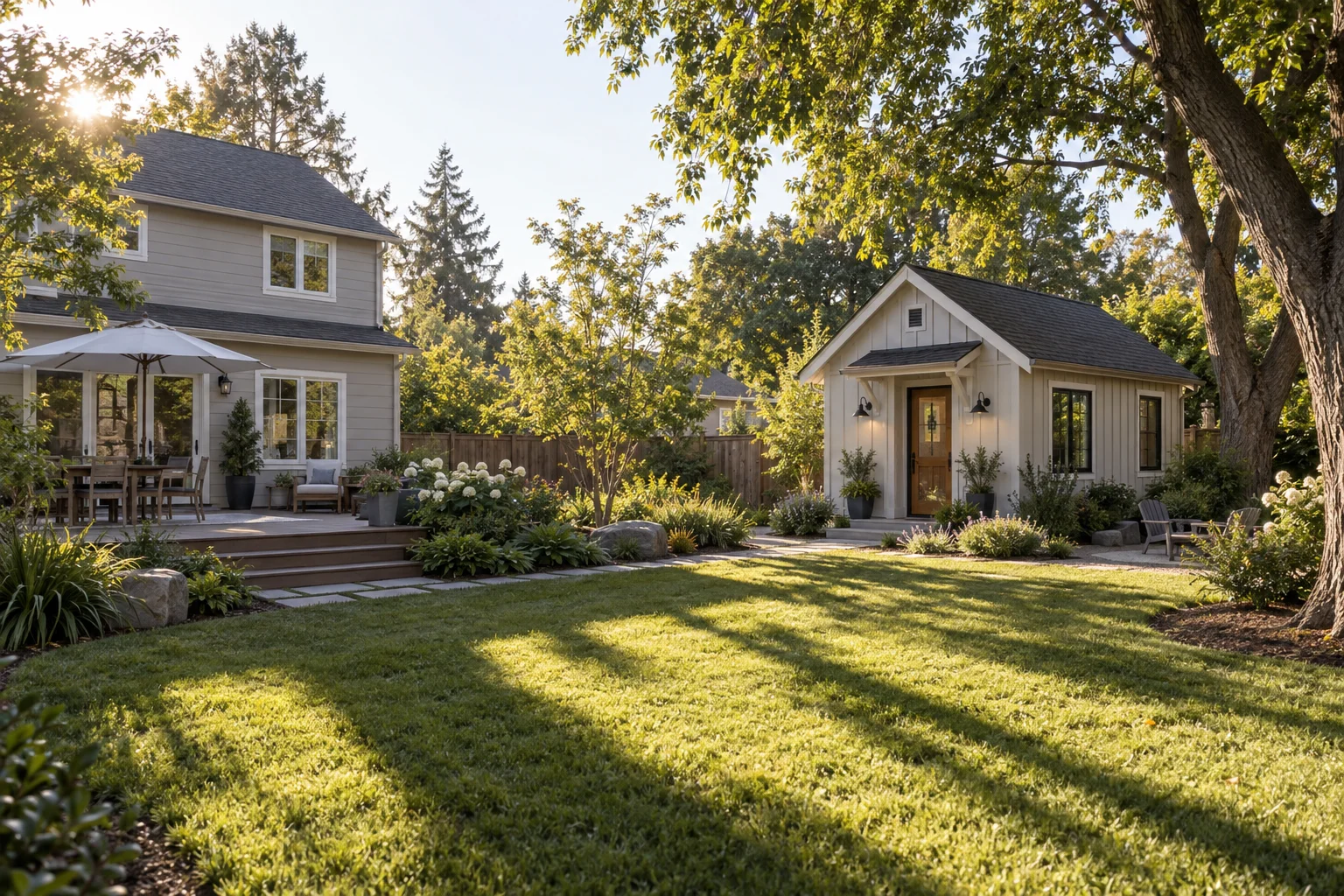
Florida has no statewide right to build an accessory dwelling unit. Section 163.31771 of the Florida Statutes lets a county or city adopt an ADU ordinance, and the Legislature has rejected three straight bills that would have turned that permission into a mandate.
So Florida ADU laws, in practice, are your local zoning code: Tampa requires you to live on site, unincorporated Pasco County does not, and St. Petersburg bans short-term rental of the unit outright.
Florida ADU laws in one answer: legal only where your city allows it
You can build an ADU in Florida only where the county or municipality has adopted an ordinance permitting one. Under the Florida ADU statute, an accessory dwelling unit is "an ancillary or secondary living unit, that has a separate kitchen, bathroom, and sleeping area, existing either within the same structure or on the same lot as the primary dwelling unit."
The operative sentence in subsection (3) says a local government "may adopt an ordinance to allow accessory dwelling units in any area zoned for single-family residential use." Nothing in the section requires any local government to do so.
That permissive language is unchanged as of September 23, 2026. The last amendment to the statute took effect July 1, 2020. Chapter 2026-179 (HB 1389), approved by the Governor on June 26, 2026 and effective July 1, 2026, contains ADU provisions that cite § 163.31771, but the statute's history line on Online Sunshine shows no amendment to the text itself. Anyone building in 2026 should read the enrolled chapter text before assuming the old framework is intact.
For a property in your portfolio, the first question is whether the jurisdiction has an ordinance on the books. These do:
- Unincorporated Miami-Dade County adopted Sec. 33-22 through Ordinance 22-146 on November 1, 2022.
- Jacksonville passed Ordinance 2022-0448-E on November 9, 2022, and revised it with Ordinance 2024-0870-E in January 2025.
- Tampa allows ADUs as a Special Use-1 only in Seminole Heights, the area around Lowry Park, the East Tampa Overlay and the Tampa Heights Overlay.
- St. Petersburg expanded eligibility under Ordinance 509-H (July 14, 2022) and amended standards under Ordinance 611-H (July 10, 2025).
- Orlando adopted Sec. 58.501 through Ordinance 2018-44 (September 4, 2018) and amended it with Ordinance 2022-29 (May 16, 2022).
- Pasco County created LDC Sec. 530.24 through Ordinance 25-22, effective April 11, 2025.
- Pinellas County updated its ADU rules effective September 9, 2024, waiving development-review fees and raising the size cap.
Where no ordinance exists, the statute gives you no independent right to apply. Local code governs everything that follows in this article.
What Florida statute 163.31771 actually says
The statute encourages ADUs, defines them, and imposes one condition on every building permit: an affordable-rent affidavit. The legislative finding in subsection (1) states that it serves an important public purpose to encourage permitting of ADUs in single-family areas to increase the supply of affordable rentals for extremely-low, very-low, low or moderate-income persons. "Affordable rental housing" means monthly rent and utilities not exceeding 30 percent of the applicable median adjusted gross annual income threshold.
Subsection (4) is the part investors miss. It reads: "An application for a building permit to construct an accessory dwelling unit must include an affidavit from the applicant which attests that the unit will be rented at an affordable rate to an extremely-low-income, very-low-income, low-income, or moderate-income person or persons."
The Florida Housing Coalition notes this wording "arguably changes the breadth of the statute to require every ADU to be used for affordable rental housing," and that "City/County Attorneys differ in opinion on the effect" of the language. Florida Housing Coalition Some jurisdictions collect the affidavit as a formality; others treat it as a use restriction. Ask the building department how yours reads it.
Subsection (5) ties ADUs to the comprehensive plan. Each unit allowed under a local ordinance counts toward the affordable housing component of the housing element under § 163.3177(6)(f). The statute contains no separate requirement that a local government amend its comprehensive plan before adopting an ADU ordinance.
The section's amendment history explains why the affidavit exists:
- Session | Bill | Chapter law | Effective date | Action
- 2004 | Not listed | ch. 2004-372, § 2 | Not listed | Original enactment
- 2006 | Not listed | ch. 2006-69, § 2 | Not listed | Amendment
- 2010 | Not listed | ch. 2010-5, § 16 | Not listed | Amendment
- 2011 | Not listed | ch. 2011-189, § 13 | Not listed | Amendment
- 2020 | CS/CS/CS/HB 1339 | ch. 2020-27, § 4 | July 1, 2020 | Added the affordable-rent affidavit requirement
- 2021–2026 | None | None | Not applicable | No further amendments enacted
Source: Florida Senate bill history
The Florida Housing Coalition's recommended local practices show what a favorable ordinance looks like: permitting ADUs in all single-family zones, allowing them by right rather than as conditional uses, reducing minimum lot size and setback requirements, waiving or reducing impact fees, exempting ADUs from density calculations, and offering expedited permitting for affordable rental ADUs. Florida Housing Coalition Orange County and Orlando have adopted several of these; Tampa has adopted almost none.
What counts as an ADU in Florida?
A structure is an ADU in Florida when it has its own kitchen, bathroom and sleeping area; the label on the plans (cottage, garage apartment, guest house, granny pod) does not matter. The statutory definition turns on those three elements, and Florida law has no separate "junior ADU" category the way California does. Local codes then sort units by how they attach to the main house:
- Detached ADU: A freestanding backyard unit. Miami-Dade applies accessory-structure setbacks to detached units of one story and principal-dwelling setbacks to anything taller, and a detached unit may not exceed the height of the main house. Sec. 33-22
- Attached ADU: A unit sharing a wall or roof with the principal dwelling. Miami-Dade and St. Petersburg both require attached units to meet the zoning district's regular setbacks. Attached construction runs $30,000–$60,000 less than detached at 600 square feet because the unit shares walls and systems. AP Advanced
- Garage conversion: An existing garage converted to a living unit. Orlando's home-sharing rules treat a "garage apartment" as an ADU. A Central Florida contractor puts the conversion at $30,000–$60,000 and notes that "Adding plumbing for a kitchen and bath is the biggest expense." J&N StructureWorks
- Small units under 500–600 square feet: Several codes reward compact units. Orlando drops the extra parking space for an ADU of 500 square feet or less if the main house's parking is compliant, and St. Petersburg exempts units of 600 square feet or less from parking when they sit on an alley within 660 feet of high-frequency transit and have no front driveway. Miami-Dade sets a 400 square foot floor. Municode Sec. 58.501
- Prefab, modular and tiny units: These qualify if they meet the definition and the Florida Building Code, 8th Edition (2023), which uses ASCE/SEI 7-22 wind standards; in the High-Velocity Hurricane Zone (Miami-Dade and Broward) products must carry Miami-Dade Product Approval under TAS 201/202/203. floridadisaster.org Miami-Dade's pre-approved ADU Blueprint and Orange County's Ready Set Orange plan sets shortcut the design review for standard layouts.
A guest house or "granny pod" with a bedroom and bath but no kitchen is not an ADU under the statute. That distinction cuts both ways. Florida Attorney General Opinion 2018-06 concluded a municipality may prohibit independent rental of an accessory structure that provides only sleeping quarters, because such a structure is not an independently licensable vacation rental under Chapter 509. A full ADU with kitchen, bathroom and sleeping area is more likely to qualify as a vacation rental and fall under state preemption. Florida AG Opinion
The local rules that decide your project: size, setbacks, height, lot size and parking
Size caps in the major Florida jurisdictions run from a reported 750 square feet in Jacksonville to 1,200 square feet in Pasco County, and lot minimums range from 4,500 square feet in St. Petersburg's NT districts to 15,000 square feet for a large unit in Orlando's R-1AA district. The comparison table in the next section lays those caps side by side. This section covers the dimensional rules that trip up site plans.
Lot size minimums
Orlando scales the lot minimum to both the zoning district and the unit size, and it also caps floor area ratio at 0.50 across the whole lot, so a large house on a small lot may have no FAR left for an ADU even if the lot minimum is met:
- District | ADU up to 500 sq ft | ADU up to 1,000 sq ft
- R-1AA | 10,000 sq ft | 15,000 sq ft
- R-1A | 7,700 sq ft | 11,550 sq ft
- R-1 | 6,000 sq ft | 9,000 sq ft
- R-1N | 5,500 sq ft | 8,250 sq ft
Source: Orlando ADU handout
Miami-Dade requires 7,500 square feet in RU-1 districts. St. Petersburg requires 4,500 square feet in NT districts and 10,000 square feet in NS districts, with exceptions. Pasco sets no ADU-specific minimum and applies the underlying district standard. Pasco County ADU page
Septic lots carry a second layer. State law requires at least a half acre (21,780 square feet) for a lot on a private water system and limits sewage flow to 1,500 gallons per acre per day; lots on public water may have no more than four lots per acre and 2,500 gallons per acre per day. § 381.0065(4) Levy County requires a full acre for a principal home plus ADU, and Alachua County requires the Health Department to confirm combined flow under 700 gallons per day on rural lots under five acres. Alachua County ADU page
Setbacks and height
Tampa's general standards are the most demanding of the group, and they tighten further when the ADU footprint exceeds 15 percent of the lot:
- Setback | Baseline | If ADU exceeds 15% of lot size
- From front street | 60 ft | No change
- From principal structure | 5 ft | No change
- From side street | 7 ft | 7 ft
- From interior side lot line | 3 ft | 7 ft
- From rear lot line | 3 ft | 20 ft
Source: Tampa 2025 ADU guide
Seminole Heights gets its own reduced set under Sec. 27-211.2.1: 3 feet on the interior side, side street and rear, with 5 feet of separation from the main house. Seminole Heights guide
Elsewhere the rule keys off the principal structure. Miami-Dade requires attached and multi-story detached ADUs to match the principal dwelling's setbacks and lot coverage; a detached unit may not be taller than the main house.
Jacksonville lets accessory structures under 15 feet sit in a required rear or side yard, but no closer than 5 feet to a lot line; anything over 15 feet meets primary-structure setbacks and cannot exceed its height. Municode Sec. 656.403
St. Petersburg requires a 10-foot side yard for a detached ADU in NS districts. Pasco applies principal-structure setbacks and offers a Special Exception under LDC Sec. 402.4 for deviations.
Parking
Parking rules range from one added space to none, depending on transit access and unit size. Miami-Dade requires one additional space but waives it within 660 feet of a major transit or mixed-use corridor. Tampa requires one space per unit. Orlando requires one added independently accessible space only for units over 500 square feet. Pasco requires on-site parking unless permanent on-street parking is permitted, with the count set by LDC Sec. 907.1. Pasco County ADU page
City and county comparison: where Florida ADUs are allowed
Among the major jurisdictions with confirmed rules, owner-occupancy is the rule that separates Tampa from the others, and short-term rental status is where the codes diverge most. The table below consolidates the current rules as of the code editions cited in the research:
- Jurisdiction | Max ADU size | Min lot size | Owner-occupancy required? | Parking | Short-term rental status | Governing ordinance
- Miami-Dade County (unincorporated) | 400–800 sq ft (RU-1) | 7,500 sq ft (RU-1) | No; owner of principal dwelling must hold an annually renewed Certificate of Use | 1 added space; exempt within 660 ft of major transit corridor | ADU cannot be its own STR listing; 1-month minimum lease | Sec. 33-22; Ord. 22-146 (Nov. 1, 2022)
- Jacksonville/Duval | Reported 25% of principal or 750 sq ft, whichever is less (news account of 2022 ordinance; not confirmed after the Jan. 2025 amendment) | Not confirmed in retrieved code | Not confirmed in retrieved code | Not confirmed in retrieved code | Rentals under 1 week classified as motel/hotel use; no express ADU minimum | Sec. 656.403; Ord. 2022-0448-E; Ord. 2024-0870-E
- Tampa | 950 sq ft | Not stated in retrieved sources | Yes | 1 space per unit | No stated minimum; owner-occupancy and four-neighborhood limit constrain STR | Sec. 27-132, Sec. 27-156; through Ord. 2025-152 (Dec. 18, 2025)
- St. Petersburg | 800 sq ft or 67% of principal, whichever is less | 4,500 sq ft (NT); 10,000 sq ft (NS) | No; Business Tax Certificate required if both units are rentals | Per parking matrix; exemption for ≤600 sq ft on alley near transit | Prohibited; unit "shall not be utilized as a transient accommodation use"; 30-day minimum | Sec. 16.50.010; Ord. 509-H; Ord. 611-H
- Orlando | 1,000 sq ft, within 0.50 FAR and smaller than principal | 6,000–15,000 sq ft by district and unit size | No; owner must own both units, no separate sale | 1 added space only for ADU >500 sq ft | Hosted home sharing only (owner or tenant on site, one booking at a time, half the unit); no unhosted whole-ADU STR without Commercial Dwelling Unit classification | Sec. 58.501; Ord. 2018-44; Ord. 2022-29
- Pasco County | 1,200 sq ft, smaller than principal | No ADU-specific minimum | No | On-site unless permanent on-street parking permitted | Rentals under 180 days prohibited unless approved under LDC Sec. 402.5.B | LDC Sec. 530.24; Ord. 25-22 (eff. Apr. 11, 2025)
Sources: Miami-Dade Sec. 33-22 | City of Tampa | St. Pete ADU page | Orlando Sec. 58.501 | Pasco Ord. 25-22
The Jacksonville row carries a caveat worth repeating. The 750 square foot figure comes from news coverage of the 2022 ordinance, and Ordinance 2024-0870-E revised the rules in January 2025 without the final codified text appearing in the retrieved sources. Confirm Sec. 656.403 with the City Clerk before you design to that number.
Three smaller jurisdictions round out the picture. Pinellas County raised its maximum ADU size from 750 to 1,000 square feet and waived development-review fees effective September 9, 2024. Pinellas County ADU update Unincorporated Alachua County requires the ADU to share a septic and well with the main house where central utilities are unavailable, and it expressly allows short-term rental if the unit is permitted, tourist tax is paid, and the owner lives on the property in either unit. Alachua County ADU page Volusia County waives utility impact fees for an ADU that shares connections, well or septic with the principal home. Volusia County ADU handout
Can you rent it out? Short-term bans, long-term rules and owner-occupancy
Long-term rental of an ADU is permitted in every major Florida jurisdiction surveyed, and short-term rental is banned or heavily restricted in most of them. Whether those local bans survive state preemption is an open legal question.
The state preemption problem
Florida Statute § 509.032(7) says "A local law, ordinance, or regulation may not prohibit vacation rentals or regulate the duration or frequency of rental of vacation rentals." The prohibition exempts local ordinances adopted on or before June 1, 2011. Florida Senate Miami Beach's six-months-and-a-day rule dates to Ordinance 2010-3685 (June 9, 2010) and is grandfathered. Miami Beach STR page
Local governments adopted every ADU-specific minimum lease term in the state after that cutoff, including Miami-Dade's one month, Pasco's 180 days, St. Petersburg's transient-accommodation ban and Sarasota County's 30-day rule. Whether each survives depends on whether the ADU qualifies as a "vacation rental" under § 509.242(1)(c), and no final court decision has resolved that for ADUs. The Legislature recognized the conflict: 2026 SB 48 would have expressly let local governments "prohibit the renting or leasing of an accessory dwelling unit … for a term of less than 1 month, notwithstanding s. 509.032(7)(b)." It died in House messages on March 13, 2026, and Chapter 2026-179 does not contain the provision. SB 48 bill text
An investor underwriting an ADU as an Airbnb in Miami-Dade or Pasco is betting on either winning a preemption challenge or on a code enforcement office declining to act. The rent roll should assume the local rule holds.
Rules outside the six big jurisdictions
- Unincorporated Sarasota County requires 30-day minimums in most areas and allows STR only on Siesta, Casey and Manasota Keys under Ordinance 2019-024.
- The City of Sarasota allows STR citywide with registration and a 7-night minimum under Zoning Code §§ II-304(b)(1) and VI-202(b).
- Unincorporated Collier County has no ADU-specific STR ban but requires registration for sub-30-day rentals that occur more than three times a year under Ordinance 2021-45.
- Alachua County allows ADU short-term rental outright when the owner lives on the property, tourist tax is paid, and the unit is permitted.
Owner-occupancy and the paperwork that replaces it
Among the major Florida jurisdictions with confirmed rules, Tampa is the only one that requires the owner to live on the property. Miami-Dade, St. Petersburg, Orlando and Pasco impose no such requirement, which is what makes an ADU viable for an investor who owns the whole parcel as a rental. Each of them substitutes a document:
- Miami-Dade requires the owner of the principal dwelling to obtain a Certificate of Use for the ADU and renew it every year. Sec. 33-22
- St. Petersburg states that "The main unit does not need to be homesteaded or owner-occupied; however, if both units are rentals, a Business Tax Certificate is required." St. Pete ADU page
- Pasco County requires a recorded ADU affidavit acknowledging the 180-day rental restriction and other conditions.
- Orlando requires common ownership of both units with no separate sale, and its hosted home-sharing rule requires the owner or tenant to be present during any short-term stay.
The statutory affordable-rent affidavit under § 163.31771(4) sits on top of all of these at the building permit stage.
Can an HOA block your ADU even if the county approves it?
Yes. An HOA declaration that prohibits outbuildings such as garage apartments or guest houses, or that limits use to single-family residential purposes, is enforceable in Florida even where the county or city permits an ADU, and no enacted statute as of September 23, 2026 preempts that authority.
Florida's Second District Court of Appeal stated the rule directly in Riviera-Fort Myers (2020): "it is well established that restrictive covenants can be more restrictive than limitations imposed by municipalities." Justia
The line of cases behind it is long. In Stuart Sportfishing, Inc. v. Kehoe, 541 So. 2d 169 (Fla. 4th DCA 1989), a less restrictive zoning ordinance did not control over a stricter covenant. In Luani Plaza, Inc. v. Burton, 149 So. 3d 712 (Fla. 3d DCA 2014), an association barred residential use the municipality had allowed. Tolar v. Meyer, 96 So. 2d 554 (Fla. 3d DCA 1957), reached the same result for a church.
The case closest to an ADU is Wilkes v. Kreutler, 157 So. 2d 194 (Fla. DCA 1963). The court enforced a restriction providing that "no trailer, tent, garage, garage apartment, or other outbuilding may be erected except a garage for not more than two cars," and found evidence of changed neighborhood conditions insufficient to lift it. Justia Declaration restrictions carry what Hidden Harbour Estates, Inc. v. Basso, 393 So. 2d 637 (Fla. 4th DCA 1981), called "a very strong presumption of validity," overcome only by showing they are "wholly arbitrary in their application, in violation of public policy, or that they abrogate some fundamental constitutional right."
The statutes reinforce this. § 720.305(1) requires every member to comply with governing documents and lets the board fine continuing violations. § 720.3035(1)(a) limits architectural authority to what the declaration states or reasonably implies and requires written reasons for a denial, but it does not create any right to build. flsenate.gov
Section 163.31771 contains no language touching private covenants. The 2024 HOA reform (Chapter 2024-221) only bars enforcement of covenants over structure interiors not visible from the street or adjacent parcels. flsenate.gov analysis
The failed 2025 SB 184 would have gone the other way on local governments but expressly excluded planned unit developments and master planned communities from any mandate. flsenate.gov analysis
Before you spend money on drawings, pull the recorded declaration and read for four things:
- A list of prohibited structures, including outbuildings and guest houses, plus terms such as garage apartments or "second residences."
- A "single-family residential use" clause, which courts have read to bar a second household on the lot.
- Leasing restrictions governing the minimum term and number of tenants, plus restrictions on renting any portion of the lot.
- Architectural review requirements and the board's stated approval criteria under § 720.3035.
If the covenant is against you, the available defenses are narrow: changed conditions making enforcement inequitable, selective or arbitrary enforcement under White Egret Condominium, Inc. v. Franklin, 379 So. 2d 346 (Fla. 1979), an amendment that works a "radical change" destroying the general plan under Holiday Pines Property Owners Ass'n v. Wetherington, 596 So. 2d 84 (Fla. 4th DCA 1992), or ambiguous covenant language construed narrowly under Wilson v. Rex Quality Corp., 839 So. 2d 928 (Fla. 2d DCA 2003). None of these is a preemption argument, and each requires litigation.
Permitting step by step: zoning check, septic sign-off, building permit, inspections, Certificate of Use
A detached ADU in Orlando moves through six gates, and the impact-fee gate is where the budget swings the most. The walkthrough below uses a 600 square foot detached unit behind an existing 1,800 square foot house on an R-1 lot with city sewer; Orlando publishes the most complete fee data of the jurisdictions surveyed, so the numbers are concrete.
- Zoning check. Confirm the lot meets the R-1 minimum of 6,000 square feet for an ADU up to 500 square feet or 9,000 square feet for one up to 1,000 square feet, that the combined floor area stays under the 0.50 FAR cap, and that the unit will be smaller than the house. A 600 square foot unit exceeds 500, so one added independently accessible parking space is required. Orlando ADU handout
- Sewer or septic sign-off. On city sewer, the utility (OUC for power) requires addresses, account creation, a meter-installation request and permit clearance. OUC Development Services Guide On septic, the sequence flips: any alteration that increases estimated sewage flow requires DEP reapproval before you touch the structure or the system. A one-bedroom unit under 750 square feet adds 100 gallons per day under Table I of F.A.C. R. 62-6.008, and the drainfield must be enlarged to current sizing for the new total flow. On a lot of one acre or less in a BMAP or springs area without sewer, the new system must be an enhanced nutrient-reducing unit achieving at least 65 percent nitrogen reduction. § 403.067(7)(a)10 If the ADU adds no bedroom, § 381.0065(4)(bb) waives the septic upgrade.
- Plans, affidavit and building permit. Submit signed plans meeting the 8th Edition Florida Building Code, wind-load and impact-glazing requirements for the site, and the § 163.31771(4) affordable-rent affidavit. Orlando's permit fee, effective January 2026, is $66.24 for the first $1,000 of valuation plus $4.41 per additional $1,000, plus a 3 percent technology surcharge. Orlando residential fees PDF On a $150,000 valuation that works out to roughly $745 including the surcharge.
- Impact fees. Orlando exempts ADUs from the school impact fee under Ordinance 2020-35. Orlando assesses the transportation fee only when the combined conditioned living area (existing house plus ADU) crosses into a higher tier; the tiers are $3,898 up to 1,200 square feet, $5,645 for 1,201–2,000, $7,069 for 2,001–3,500 and $7,397 at 3,501 and up. Our 1,800 plus 600 example lands at 2,400 square feet, one tier above the existing house. The sewer benefit fee for a typical ADU addition nets to about $1,319.50 after the single-family credit. Orlando ADU impact fees Orlando's ADU Incentive Program rebates 100 percent of park, transportation and sewer impact fees and 100 percent of building permit fees, plus up to $10,000 toward construction, if you rent to a household at or below 120 percent of AMI for 12 of the first 24 months after the certificate of occupancy. Orlando ADU Incentive Program
- Inspections and certificate of occupancy. Inspections track the trade sequence (foundation, framing, electrical, plumbing, mechanical, final). For the electrical inspection, a feeder from the main house panel to a subpanel in the ADU is a permitted path under NEC 225.30 and 230.2, with a disconnect at the ADU under 225.32 and a grounding electrode system under 250.32. FBC Staff Analysis The certificate of occupancy also starts the clock on the incentive program's rental covenant and on property tax assessment (next January 1 after substantial completion).
- Use certificate or registration. Orlando requires no separate ADU certificate, but if you plan hosted home sharing you must register under Chapter 58, Part 5B. In Miami-Dade the equivalent step is the annual Certificate of Use; in St. Petersburg it is the Business Tax Certificate when both units are rented; in Pasco it is the recorded ADU affidavit.
The research corpus does not include published permit review times for these jurisdictions. Two external clocks shape the schedule regardless. NAHB's June 2025 study found the skilled-labor shortage adds an average of 1.98 months to residential construction time. NAHB Fannie Mae HomeStyle Renovation requires completion within 15 months (18 with approval), and Freddie Mac's CHOICEReno eXPress requires completion within 180 days of the note date. If you finance the build with either, the lender's deadline becomes the schedule.
What it costs: construction, impact fees, utility connections and financing
A detached ADU in Florida costs $200–$350 per square foot to build in 2026, and soft costs consume 25–35 percent of the total budget. Protech Where the property sits changes the total more than anything else in the budget.
Construction
Contractor estimates by market and unit type show a wide spread:
- Unit type | Market | Estimate | Source and date
- Detached, compact | Florida statewide | $95,000–$170,000 all-in | Protech, 2026
- Detached, 600 sq ft | Orlando | $111,750–$186,750 ($225–$300/sq ft) | LotCheck, 2026
- Detached, 400–600 sq ft | Central Florida | $80,000–$150,000 | J&N StructureWorks, Sept. 1, 2025
- Detached, 600–1,000 sq ft | Central Florida | $120,000–$200,000+ | J&N StructureWorks, Sept. 1, 2025
- Detached, 500 sq ft | Jacksonville | $150,000–$220,000 | AP Advanced, Nov. 2025
- Detached, 800 sq ft | Jacksonville | $200,000–$300,000 | AP Advanced, Nov. 2025
- Attached, 800 sq ft | Jacksonville | $160,000–$230,000 | AP Advanced, Nov. 2025
- Garage conversion, ADU level | Central Florida | $30,000–$60,000 | J&N StructureWorks, Sept. 1, 2025
- Garage conversion, full living suite | Sarasota | $85,000–$140,000 ($180–$250+/sq ft) | Homes By Strong, May 2025
Sources: Protech | LotCheck | J&N StructureWorks | AP Advanced | Homes By Strong Sarasota
Protech's itemized soft costs for a 550 square foot detached unit run $6,000–$10,000 for architecture and engineering, $3,000–$6,000 for permits, $6,000–$12,000 for site preparation and $10,000–$18,000 for impact fees. LotCheck puts Orlando soft costs at $25,000–$50,000 on a detached build. Hurricane requirements drive part of the premium over national averages: impact-resistant or protected glazing in wind-borne debris regions, Base Flood Elevation compliance in Zones A/AE and V per the December 2024 FDEM guidance on accessory structures. FDEM guidance Gordian's 2025 RSMeans data shows construction labor wages up 4.1 percent year over year. Gordian
Impact fees by county
Impact fees range from $100 in Hillsborough to more than $14,000 in Miami-Dade for the same unit, which is the single largest reason to compare jurisdictions before buying a lot for an ADU play:
- Jurisdiction | ADU impact fee treatment | Source
- Miami-Dade County | Mobility $9,275–$10,625 per unit; Fire $527.55; Police $688.42; School $612 per unit plus $0.918 per gross sq ft; Parks $3,084–$4,903; workforce housing exemption up to 120% AMI | Miami-Dade impact fee rates
- Orange County (unincorporated) | ADUs ≤1,500 sq ft exempt from law enforcement, fire, parks, transportation and school fees; larger ADUs pay single-family rates except transportation and school | Orange County fee guide
- City of Orlando | School exempt; transportation only on tier change; sewer benefit ~$1,319.50 net | Orlando ADU impact fees
- Hillsborough County | $100 de minimis ADU fee per Florida Housing Coalition; current amount not confirmed in the county's RS25-111 tables | Florida Housing Coalition
- Jacksonville | Ten-zone mobility fee calculated per site; $688 calculation application fee | Jacksonville mobility fee app
- Pinellas County | Development-review fees waived for ADUs (eff. Sept. 9, 2024) | Pinellas County
- Volusia County | Utility impact fees waived when ADU shares connections, well or septic with the main house | Volusia County
Florida caps how fast any of these can rise. Under § 163.31801, an increase of 25 percent or less phases in over two years, an increase between 25 and 50 percent phases in over four, no ordinary increase may exceed 50 percent, and no increase may occur more than once every four years. Subsection (11) lets local governments waive impact fees for affordable housing without offsetting revenue. Fla. Stat. § 163.31801
Utility connections: separate meter or subpanel?
The electrical code does not require a separate utility service for an ADU, but the utility tariff or the Public Service Commission may. NEC 230.2 permits only one service per building; a feeder from the main house to a subpanel in the detached unit satisfies the code. NEC 225.30 FPSC Rule 25-6.049(5), however, requires individual metering for each separate occupancy unit of a new residential building, so an ADU rented to a separate household triggers a separate meter account. Rule 25-6.049 FPL's tariff states "All residential service required on the premises by Customer shall be supplied through one meter. Resale of service is not permitted." JEA provides "only one point of service to a building or structure." Tampa allows only one domestic water meter per residence or legal description. City of Tampa
Connection charges vary as much as impact fees. Miami-Dade WASD charges $1.39 per average daily gallon for water and $5.60 for sewer (FY 2025-26). Orange County Utilities charges $2,790 per ERC for water and $5,270 per ERU for wastewater. Tampa's combined water and wastewater capacity fee ranges from $2,950 in most areas to $4,981 in the Northeast sub-area, with $0 for affordable housing. JEA's water tap fee for a 3/4-inch meter is $1,360 and a 6-inch sewer tap runs $8,330, plus plant capacity charges of $4.68 per gallon for water and $25.57 per gallon for sewer. JEA tariff
Financing
You have five realistic ways to fund a Florida ADU, and none of the state programs is a homeowner grant:
- A HELOC or cash-out refinance can draw on existing equity. Florida Credit Union quoted 6.75–8.00 percent at 80 percent LTV on April 2, 2026. Quorum FCU's renovation HELOC lends up to 95 percent of after-renovated value and explicitly permits one ADU on a one-unit primary residence. Quorum renovation HELOC Freddie Mac permits cash-out refinance on properties with ADUs; Florida DSCR investor loans run to 80 percent LTV at a 720 score.
- With an FHA Standard 203(k), Mortgagee Letter 2023-17 made ADU additions eligible, with ADU rental income capped at 30 percent of effective income and 50 percent of estimated rent usable for a new attached unit. The Limited 203(k) ceiling rose to $75,000 in November 2024, but new detached construction still requires the Standard program. HUD ML 2024-13
- Fannie Mae HomeStyle Renovation finances a detached ADU at up to 97 percent LTV with renovation costs up to 75 percent of as-completed value. SEL-2025-10 (effective March 31, 2026) allows up to three ADUs on a one-unit property. ADU rent counts toward qualifying income up to 30 percent under SEL-2025-08. Fannie Mae SEL-2025-10
- Freddie Mac CHOICERenovation adds or renovates one ADU on 1-, 2- or 3-unit properties at 95 percent LTV. Bulletin 2026-1 bars using rental income from the unit under renovation for applications on or after May 4, 2026.
- For a construction-to-permanent loan, MIDFLORIDA quoted 7.125 percent (7.254 percent APR) with 10 percent down on September 1, 2026; Space Coast CU quoted 6.625 percent (6.714 percent APR) at up to 90 percent on July 22, 2026. midflorida.com
SHIP dollars ($163.8 million statewide for FY 2025-26) reach ADUs only through each local government's Local Housing Assistance Plan, and rental development is limited to 25 percent of the allocation.
Hometown Heroes exhausted its $50 million for FY 2025-26 and funds purchases, not construction. Live Local SAIL is a developer gap-loan program.
PACE cannot fund new ADU construction under § 163.08; it finances qualifying improvements to a unit that already has a certificate of occupancy, and only in jurisdictions that have authorized residential PACE since the July 1, 2024 law change. Fla. Stat. § 163.08
Miami-Dade barred new PACE applications in December 2023; Hillsborough re-adopted it for unincorporated areas in April 2025.
Taxes, homestead exemption and resale value after you build
Building an ADU adds the unit's full market value to your assessment on the first January 1 after completion, and renting it can cost you the homestead exemption on that portion of the property. The Save Our Homes cap on the rest of the property survives.
Under § 193.155(4)(a), "Changes, additions, or improvements to homestead property shall be assessed at just value as of the first January 1 after the changes, additions, or improvements are substantially completed." The existing home keeps its capped assessed value; the ADU is added at just value; from the second year on the combined base grows no faster than 3 percent or CPI. Fla. Stat. § 193.155 The Miami-Dade Property Appraiser puts it plainly: "New construction, alterations or improvements are not capped the first year they are placed on the tax roll but are thereafter." Miami-Dade PA Hillsborough, Orange, Palm Beach and Pinellas appraisers apply the same rule.
Renting the unit is the bigger tax event. § 196.031(4) limits the homestead exemption to the "portion" of property classified and assessed as owner-occupied. The Florida Supreme Court in Furst v. Rebholz held "the owner is not entitled to a homestead tax exemption on the rented portion, because that portion is not the owner's residence," and the test is use rather than physical structure. Florida Supreme Court Pinellas applies it this way: "if you own a duplex, live in one half and rent the other half to a tenant, only 1/2 of your property value will be capped by the Save-Our-Homes cap." Pinellas PA You must notify the county property appraiser and request removal of the exemption from the rented portion. DOR guidance
Two further thresholds apply if you stop living in the main house. Renting "all or substantially all" of a homestead for more than 30 days per calendar year for two consecutive years abandons the homestead under § 196.061(1). Haddock v. Carmody, 1 So. 3d 1133 (Fla. 1st DCA 2009), found 113, 104 and 66 nights of short-term rental over three years met that test even with two locked closets reserved.
Section 196.012(13) presumes that property rented for more than six months serves a commercial purpose. The 2025 SB 184 would have barred denial of homestead solely because a property contains a rented ADU and assessed the ADU separately; it died June 16, 2025, so no such protection exists.
On resale, Orlando's code and Freddie Mac's appraisal rules establish two concrete constraints rather than a value premium. Orlando prohibits selling the ADU separately from the main house, so the sale price covers the whole parcel.
Freddie Mac's appraisal rules require at least one comparable sale with an ADU and three comparable rentals for any rental analysis. In neighborhoods with few ADUs, an appraiser may struggle to credit the unit's income. Freddie Mac ADU fact sheet
The drawbacks stack on the cost side: $95,000–$300,000 in construction depending on market, four- to five-figure impact fees outside Orange County and Pinellas, a partial homestead loss if you rent, an unresolved STR preemption fight, a possible HOA veto, and a separate insurance bill that the next section covers.
Insuring a Florida ADU
A standard HO-3 policy covers detached other structures under Coverage B, usually at 10 percent of the dwelling limit. The form, however, excludes "other structures rented or held for rental to any person not a tenant of the dwelling, unless used solely as a private garage." III HO-3 Sample That exclusion can leave a detached backyard ADU outside Coverage B when you lease it to a separate tenant, including when a fire damages the rented cottage.
Owners commonly address that rental exposure with a landlord insurance policy on a dwelling fire form. NAIC's 2025 definitions describe the tiers: DP1 covers fire, lightning and internal explosion; DP2 provides intermediate named-peril coverage; DP3 uses an open-peril basis for the dwelling and attached structures, subject to named exclusions such as flood. NAIC 2025 A DP3 also pays fair rental value when a covered loss makes the rented portion "unfit for its normal use." Under a Steadily policy that means dwelling coverage on the structure, liability from $100K to $1M+, and loss of rental income up to 12 months of fair rental value. Steadily writes ADU insurance as a named property type in all 50 states, and it covers short-term rentals on Airbnb and VRBO, which matters in Alachua County or the City of Sarasota where an ADU STR is legal.
Two Florida-specific problems follow. Hurricane deductibles are separate from the standard deductible: insurers must offer $500, 2, 5 and 10 percent of the dwelling limit, applied per calendar year. Florida OIR May 2025 checklist Wind mitigation credits under § 627.0629 reduce the wind portion of premium for roof covering, roof-to-wall connections, roof shape, secondary water resistance and shutters; OIR's updated inspection form OIR-B1-1802 took effect April 1, 2026, and a new ADU built to the 8th Edition code should score well on it. Florida OIR
Flood is excluded from every dwelling fire form and needs its own policy. FEMA's June 2025 commentary states that "Detached structures used as residential living quarters, including Accessory Dwelling Units (ADUs), do not qualify for the 10 percent detached garage extension and are not considered detached garages under the SFIP," and the NFIP Dwelling Form insures one building per policy. FEMA requires a detached Florida ADU in a flood zone to carry its own NFIP policy. FEMA SFIP Commentary
Expect Florida pricing to sit well above national figures. OIR reported a statewide average homeowners premium of $3,757 including wind as of September 30, 2025, with Broward County at $6,220 and Alachua County at $2,527. OIR January 2026 report Steadily prices the wind peril at the parcel level using ZestyAI hail and wind models and Moody's RMS hurricane analytics, so a concrete-block ADU with a hip roof and impact glazing is rated on its own features rather than a county average. The market has softened: OIR counted 21 new insurers since the 2022–2023 reforms and an 83 percent pooled combined ratio for Florida domestic carriers at year-end 2025, and the Commissioner approved further homeowners rate decreases in September 2026.
If you already carry Landlord insurance in Florida on the main house, adding the ADU is a coverage change rather than a new relationship. Get a quote in minutes at quote.steadily.com, no phone call required.
Pending legislation: SB 48, SB 184 and what could change by 2026
No bill mandating local ADU ordinances has become Florida law, and the 2026 session ended the same way 2025 did: a Senate pass and a House death. The one enacted measure, Chapter 2026-179, left the "may adopt" text of § 163.31771 in place.
- Bill | Session | What it would change | Status
- CS/SB 1440 | 2024 | Mandatory local ADU ordinances | Died in committee
- SB 48 (Foreclosure Procedures) | 2025 | Not an ADU bill; addressed § 45.0311 | Died in Rules, June 16, 2025
- CS/SB 184 (Housing), Sen. Don Gaetz | 2025 | "May adopt" to "shall adopt" by December 1, 2025; bar owner-occupancy rules, rental bans and added parking; remove the affordable-rent affidavit; protect homestead on a rented ADU; exclude PUDs and master planned communities; Senate version allowed local bans on rentals under 30 days | Died in returning Messages, June 16, 2025, over the STR dispute between chambers
- HB 247 | 2025 | Companion ADU and homestead provisions | Not enacted
- CS/CS/SB 48 (Housing), Sen. Don Gaetz | 2026 | Mandatory local ADU ordinances by December 1, 2026; express local authority to ban ADU rentals under one month notwithstanding § 509.032(7)(b) | Passed Senate 38–0 on February 4, 2026; died in House Messages, March 13, 2026
- CS/CS/HB 1389 (Affordable Housing), Rep. Redondo | 2026 | ADU provisions citing § 163.31771; no amendment to the statute text; no HOA preemption; no STR carve-out | Approved June 26, 2026; Chapter 2026-179; effective July 1, 2026
Sources: flsenate.gov SB 184 | flsenate.gov 2026 SB 48 | flsenate.gov HB 1389
The Live Local Act (Chapter 2023-17, signed March 29, 2023) is often cited alongside ADU reform, and it does not touch ADUs. Its zoning preemption under §§ 125.01055(7) and 166.04151(7) requires local governments to allow multifamily and mixed-use rental development in commercial, industrial or mixed-use zones when at least 40 percent of units are affordable at up to 120 percent AMI for 30 years, with administrative approval and no comprehensive plan amendment. The 2024 (SB 328) and 2025 (SB 1730) amendments added FAR and parking preemptions, a July 1, 2023 baseline for density and height, and a $250,000 attorney fee cap, none of which reach single-family zones or § 163.31771. flsenate.gov
Whichever version of the Gaetz bill eventually passes will decide the STR question. The Senate has twice insisted on letting local governments ban ADU rentals under 30 days; the House has twice refused. An investor buying today for a long-term ADU rental is on the side both chambers agree on. An OPPAGA/Shimberg Center study on owner-occupied affordable housing finance due December 31, 2026 may shape the 2027 version.
FAQ
These answers summarize the rules that most often determine whether a Florida ADU project works: local approval, private covenants, rental limits, dimensional standards and property-tax effects.
Is a guest house legal in Florida without ADU approval?
A guest house with no kitchen falls outside the statutory ADU definition and is regulated as an accessory structure under the local code, subject to setback and height rules such as Jacksonville's 5-foot lot-line minimum and 15-foot height break. Attorney General Opinion 2018-06 lets a municipality prohibit renting that kind of sleeping-quarters-only structure independently, and an HOA covenant against "garage apartments or other outbuildings" was enforced in Wilkes v. Kreutler.
Are granny pods allowed in Florida?
A granny pod is treated as whatever its plumbing makes it. With a kitchen, bathroom and sleeping area it is an ADU and needs an ordinance permitting it; without a kitchen it is an accessory structure. Either way it must meet the 8th Edition Florida Building Code wind and flood requirements, and in Miami-Dade and Broward it needs Miami-Dade Product Approval for openings.
What is the biggest drawback of building an ADU in Florida?
Cost relative to legal certainty. You spend $95,000–$300,000 plus impact fees that can exceed $14,000 in Miami-Dade, lose the homestead exemption on the rented portion under Furst v. Rebholz, take on a separate landlord policy and potentially a separate NFIP flood policy, and if you planned on Airbnb income you are relying on an unresolved preemption argument in most jurisdictions.
Can an HOA override a county ADU approval?
Yes. Florida appellate courts hold that restrictive covenants may be stricter than zoning, declaration restrictions carry a "very strong presumption of validity" under Hidden Harbour, and § 163.31771 contains no HOA preemption. Chapter 2026-179 did not add one.
Can I use my Florida ADU as an Airbnb or only as a long-term rental?
It depends on the jurisdiction. St. Petersburg prohibits whole-unit short-term rentals, Pasco generally requires a 180-day minimum, and Miami-Dade requires a one-month minimum. Orlando permits hosted stays only, while Alachua County and the City of Sarasota permit short-term rentals with registration; the City of Sarasota also requires a 7-night minimum. Those post-2011 local minimums may conflict with § 509.032(7), and no court has settled it.
Do I have to live on the property to rent out an ADU in Florida?
Among the major jurisdictions with confirmed rules, only Tampa requires owner-occupancy. Miami-Dade, St. Petersburg, Orlando and Pasco impose no owner-occupancy requirement, though each substitutes a document: an annual Certificate of Use, a Business Tax Certificate when both units are rented, common ownership of both units, or a recorded ADU affidavit.
What are the size and setback limits for a Florida ADU?
Size caps in the major jurisdictions run 800 square feet in Miami-Dade and St. Petersburg, 950 in Tampa, 1,000 in Orlando and Pinellas, and 1,200 in Pasco, with Jacksonville's reported 750 cap unconfirmed after its 2025 amendment. Setbacks range from 3 feet on interior side and rear lines in Tampa's Seminole Heights to a 20-foot rear setback for a large unit under Tampa's general standards; most other codes tie the ADU to the principal structure's setbacks.
How does an ADU affect my Florida property taxes?
The county property appraiser adds the unit at just value on the first January 1 after substantial completion while leaving the existing home's Save Our Homes cap in place. From the following year, the 3 percent or CPI cap applies to the combined base. If you rent the ADU, the property appraiser removes the homestead exemption from that portion, and you must notify the appraiser yourself.



.jpg)




.png)